Fletcher Audio · Hybrid reverb
Afterspace
Real spaces meet expansive, evolving tails. Shape convolution and the Orbit algorithm together, or explore either engine on its own.
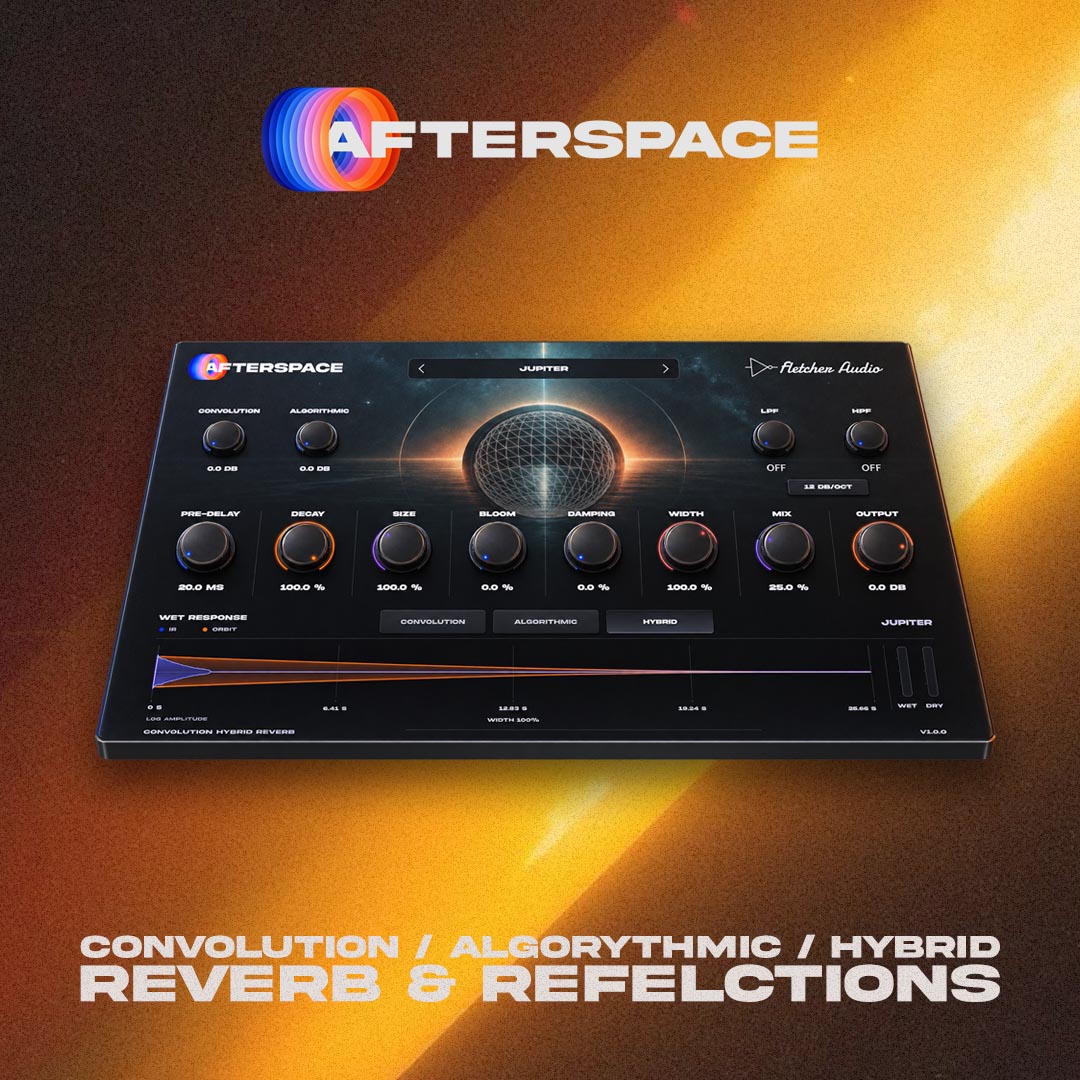
A real space. An evolving tail.
- Pre-delay
- Leave space between the original sound and the start of the reverb.
- Decay
- Shorten the captured response or open up a long Orbit tail, with smooth changes between settings.
- Size
- Spread reflections into larger spaces while preserving the impulse response’s pitch and high-frequency character.
- Bloom
- Let the reverb build around a sound with a softer, evolving onset.
- Damping
- Make high frequencies decay faster as you turn it up. At zero, no additional high-frequency damping is applied.
- Width
- Shape the stereo spread, from a focused image to a broad ambience.
- Mix / Output
- Balance the original and reverberant signals, then set the final level. Use a fully wet mix on an auxiliary return.
- Engine / Space
- Choose Convolution, Algorithmic or Hybrid, then explore 14 planet- and moon-named spaces.
- Convolution / Algorithmic gain
- Raise either wet engine from unity to +12 dB. Hybrid gives you both controls; a single-engine mode shows its own gain.
- Wet HPF / LPF
- Remove low-end weight or soften the top of the wet signal, with a shared 12, 24 or 48 dB/octave slope. The dry signal stays unchanged.
See the space you are shaping
Compatibility
System requirements
- macOS
- macOS 11 or later · Apple Silicon & IntelAudio Unit + VST3
- Windows
- Windows 10 / 11 · x64VST3 · 64-bit
AAX / Pro Tools, VST2, 32-bit and Linux builds are not included.
Choose your DAW format
| DAW | macOS | Windows |
|---|---|---|
| Logic Pro | AU | Not available |
| Ableton Live | AU / VST3 | VST3 |
| FL Studio | AU / VST3 | VST3 |
Use VST3 and the same plugin version when moving a project between Mac and Windows.
Build and validation notes
Mac packages are Developer ID signed and Apple notarized. The universal build contains Apple Silicon and Intel code; Intel hardware testing is pending. Windows VST3 and installer validation run on Windows x64. The Windows installer is not code-signed and may show a Windows reputation prompt. Not every DAW version has been tested; your host may require a newer operating system.
Installation & updates
macOS · Logic Pro, Ableton Live & FL Studio
- Save your project and close your DAW.
- Open the downloaded DMG, launch Afterspace Setup and choose Audio Unit and/or VST3. Logic Pro needs Audio Unit.
- Install, then reopen your DAW. If needed, rescan through Logic’s Plug-in Manager, Live’s Plug-ins settings, or FL Studio’s Manage plugins window.
Manual ZIP: copy Afterspace.component into ~/Library/Audio/Plug-Ins/Components/ and Afterspace.vst3 into ~/Library/Audio/Plug-Ins/VST3/. Copy each complete bundle.
Windows · Ableton Live & FL Studio
- Close your DAW, run Afterspace Setup and approve the administrator prompt.
- Reopen your DAW, enable the VST3 system folder and rescan.
- Insert Afterspace on an audio track or reverb return.
Manual ZIP: copy the complete Afterspace.vst3 bundle into C:\Program Files\Common Files\VST3\. Use the Windows build; Mac bundles cannot run on Windows.
Update or uninstall
The plugin checks for updates when its interface opens, at most once a day. Click the footer version number to check manually or disable automatic checks. Downloads remain in your AudioNode account.
Close your DAW before running a newer installer. It replaces the existing Afterspace version; the Mac installer backs up the previous plugin. To uninstall on Mac, run Uninstall Afterspace in your Applications/Fletcher Audio folder. On Windows, use Settings → Apps → Afterspace → Uninstall. Your projects and presets are preserved, but projects using a removed plugin will report it missing.
What is included?
Afterspace 1.0.0, 14 factory impulse responses, the Orbit algorithmic engine, Mac AU/VST3 and Windows x64 VST3 installers, and manual ZIP downloads. This is an effect plugin for a compatible DAW. Impulse-response attribution is included with each package.